

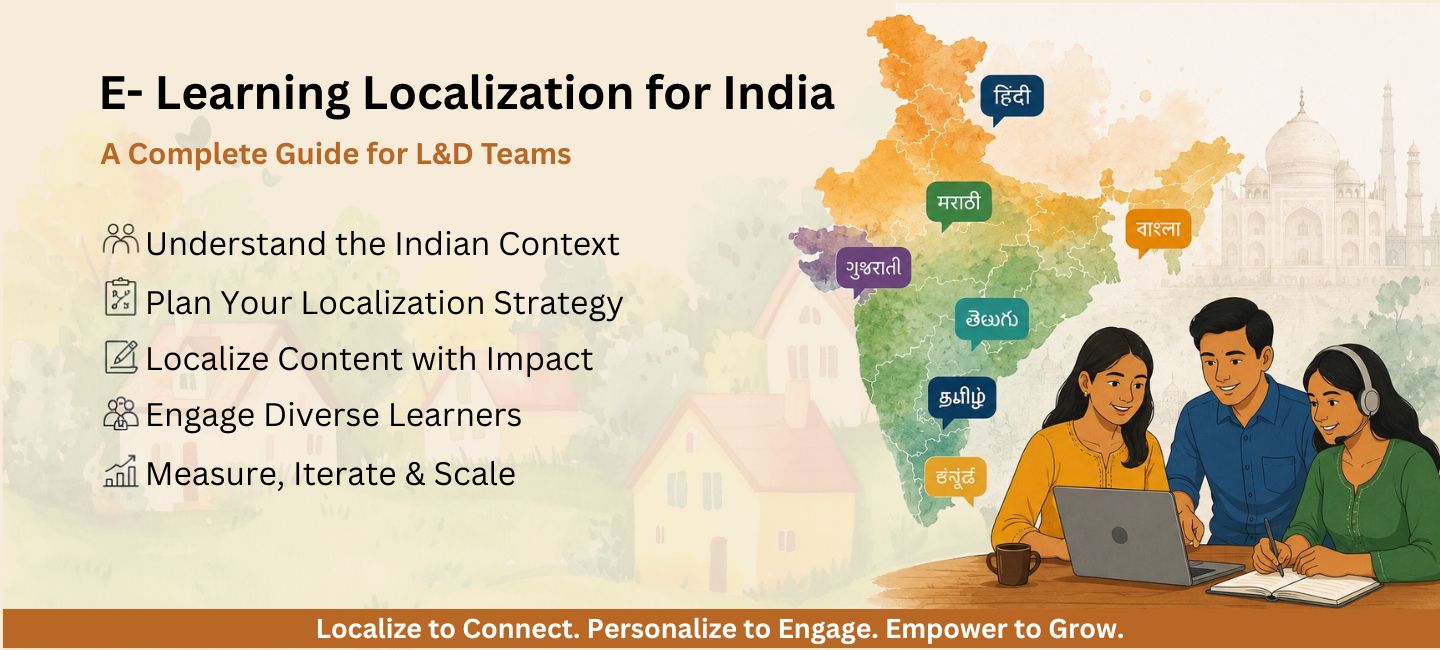
The market of digital learning in India is growing at a good pace, with corporations, educational institutes, EdTech companies and other Multinational companies heavily investing in online learning programs for their staff. However, establishing an effective training program for Indian buyers needs a lot more than just a direct translation. This is the reason why the e-learning localization India services are gaining popularity. It is so important for corporates willing to reach out to learners from different states, mother tongues and cultures to make their content region sensitive.
Learners at present want to learn through training modules in their native language, with contextualised examples, culturally relevant graphics and region-specific modes of communication. Hence, the rise in demand for eLearning translations among corporate L and D teams, HR teams, educational institutions and software companies. Here in this tutorial, we will understand about e-learning localisation, its importance for the Indian context, and how companies can produce multi-lingual learning experiences that lead to increased engagement and better knowledge retention.
What Is E-Learning Localization India and Why Does It Matter?
E-learning localization India involves customising an online course for Indian participants from various regional and cultural backgrounds. Localisation includes not only translation but also the alteration of other elements of an online course.
Among the most diverse language ecospheres in the world exists in India. There is still wide use of the English language in corporate e-Learning trainings, but millions of learners from the country opt to learn by watching e-Learning courses in Hindi, Bengali, Tamil, Telugu, Marathi, Kannada, Gujarati, Punjabi and other regional languages. Implementing appropriate professional eLearning translation services can immensely help organisations in overcoming language barriers and enhance the rate of learners’ understanding and retention.
Also, companies could maximise training completion by localising their content. Learners would have less difficulty in comprehending instructions if the material is available in their own language. It is critical, especially in manufacturing, pharmaceutical, healthcare, finance, information technology and retail industries.
One more factor contributing to e-learning localization India is the increase of remote learning after 2024. These hybrid workplaces and distributed teams need multilingual programs that can be implemented across geographies.
Key Benefits of E-Learning Localization India for Businesses
There are multiple business advantages that organizations who are putting money into e-learning localization India can derive from the benefits of localisation. Localisation enhances employee engagement in addition to improving on the learning outcomes.
Better Learner Engagement
The language feels familiar, there are localised references, and the visuals have been adapted to the culture. TraineLearning professional eLearning translation services help keep the learners interested in the course and prevent course dropout.
Improved Knowledge Retention
Time and time again, we see evidence that native language training is more effective. Materials that are tailored to local needs will help learners remember information better, understand concepts and absorb anything technically complex or regulatory.
Wider Market Reach
Indian Ed Tech firms and training companies can reach Tier-2 and Tier-3 cities in India with content in the vernacular language. E-learning localisation in India methods enable companies to tap into a new segment of learners who prefer vernacular education.
Stronger Compliance Training
The pharma, manufacturing and healthcare industry demand high reliability. If you are doing e-learning translation for this industry, high quality can spare you the risks associated with misinterpretations in health and safety, standard operating procedures, compliance modules, etc.
Higher ROI on Training Programs
Point relevant to the CE region. One of the best reasons for the localisation of course content will be the high completion rate and learner satisfaction. Organisations investing in e–learning localization India see better ROI on their learning and development budgets.
Essential Components of Successful E-Learning Localization India
Bovey, a successful e-learning localisation India projects require a variety of content that needs to be localised.
Multilingual Translation
Linguists, experienced in eLearning translation, are able to handle training scripts, subtitles, quizzes, presentations, PDFs and test papers for translation into regional Indian languages. High-quality eLearning translation maintains the technical meaning without sacrificing the natural readability.
Voiceover and Dubbing
Local language narration is critical to Video-based learning modules. Native language voice-overs improve comfort to the learner and ease-of-access in manufacturing and field training.
Cultural Adaptation
The use of examples, idioms, visuals, and situations needs to be reflective of Indian working conditions. The key to a successful India e-learning localisation program is to take cognisance of the communication to be used and to adapt it to the Indian context.
UI and Software Localisation
Harnessing learning management systems, mobile applications and navigation menus which adhere to regional writing systems and localised user interfaces. Professional eLearning translation services usually include UI testing.
Subtitle and Caption Localisation
Subtitles provide support for multilingual learners to comprehend training videos. For learners with hearing disabilities, localised captions enhance accessibility.
Industries Driving Demand for E-Learning Translation Services in India
There has been have also been a rise in the demand for eLearning translation services from a number of industries in India.
Corporate Learning and Development
Today’s large enterprises train their employees in multiple states. Multilingual Onboarding and compliance programs are one of the pillars of today’s e-learning globalisation initiatives in India.
EdTech Platforms
Indian Ed Tech companies are investing significantly in launching content in regional languages. Usage of regional language content attracts customers who are not fluent in English, and the availability of localised content positively impacts user acquisition and retention.
Healthcare and Pharmaceuticals
Hospitals and pharma companies need precise multilingual training of medical reps, HCPs and factory workers. Technical eLearning translation ensures high accuracy.
Manufacturing and Industrial Training
Employees within factories are often happy to be provided with instructions and directions on safety and the running of machinery in the local languages. Training employees locally on working machinery increases productivity and maximises safety.
Software and IT Companies
As more international software companies expand into India, they are adopting Indian-style e-learning localisation methods for training, certifications, and customer education.
Best Practices for E-Learning Localization India Projects
In order to have good localisation results, organisations should adopt procedures.
Work with Native Linguists
Native speaking translators know the regional words, understand all cultural implications and learner requirements. Always use expert knowledge in every Professional eLearning translation.
Maintain Consistent Terminology
Consistency is crucial in technical and compliance-related training. Glossaries and translation memories enhance the quality of all multi-lingual projects.
Optimise Content for Mobile Learning
Indian learners often get their training through smartphones. A thriving e-learning localization India strategy should have a mobile-friendly design and responsive layouts.
Test Localised Content Thoroughly
Localisation testing guarantees that fonts, subtitles, scripts, voiceovers and UI correctly fit each device and language.
Use Scalable Localisation Workflows
When a business goes global to other countries, scalable workflows are crucial. Seasoned providers of eLearning translation services will be able to handle a large volume of multilingual updates.
How CMM Languages Supports E-Learning Localization India
We are the leading provider of L&D soluciones de e-learning to companies, educational institutions and global corporations. We facilitate multilingual translation, voiceover localization and DTP formatting, subtitling and software localisation of e-learning platforms.
CMM Languages has a combined experience of more than 17 years in the Technical, Pharma, Legal, Manufacturing, and IT industries. CMM Languages supports companies in developing culturally appropriate eLearning for Indian users by providing professional course translation services, which are directed at specific industry knowledge requirements, language profile and engaging learners.
In addition, the company facilitates localisation into key Indian and foreign languages that enable companies to initiate their learning programs globally.
Future of E-Learning Localization India
The future of e-learning localisation in India seems to be very bright. As India’s digital economy expands, companies will turn towards multilingual learning solutions. Learning systems based on AI, microlearning systems, mobile learning services and virtual learning rooms contribute to the future of educational digitalisation. Nonetheless, human-guided knowledge should be involved in the cultural adaptation process and proper eLearning translation services.
Those businesses that undertake early investment into multilingual learning programs will enjoy increased employee engagement, improved compliance results, and expanded market penetration. Localisation is essential now for any company conducting business in multilingual India.
Conclusion
E-learning localization India has become an important business essential as the agenda of digital education and hybrid workplace has pushed everyone to deliver online education. It is no longer feasible for the organisations to just use English language learning. Training courses cannot be trusted.
E-learning translation services by professionals allow companies to develop training solutions that are relevant, effective and accessible to their diverse customer and employee base. Whether it is a multilingual subtitle, voice-over, user interface or compliance training, localising training concepts extends benefits and results across industries.
Organisations that prioritise localised learning today will be better positioned to scale training programs, improve learner satisfaction, and succeed in India’s rapidly evolving digital learning ecosystem.