

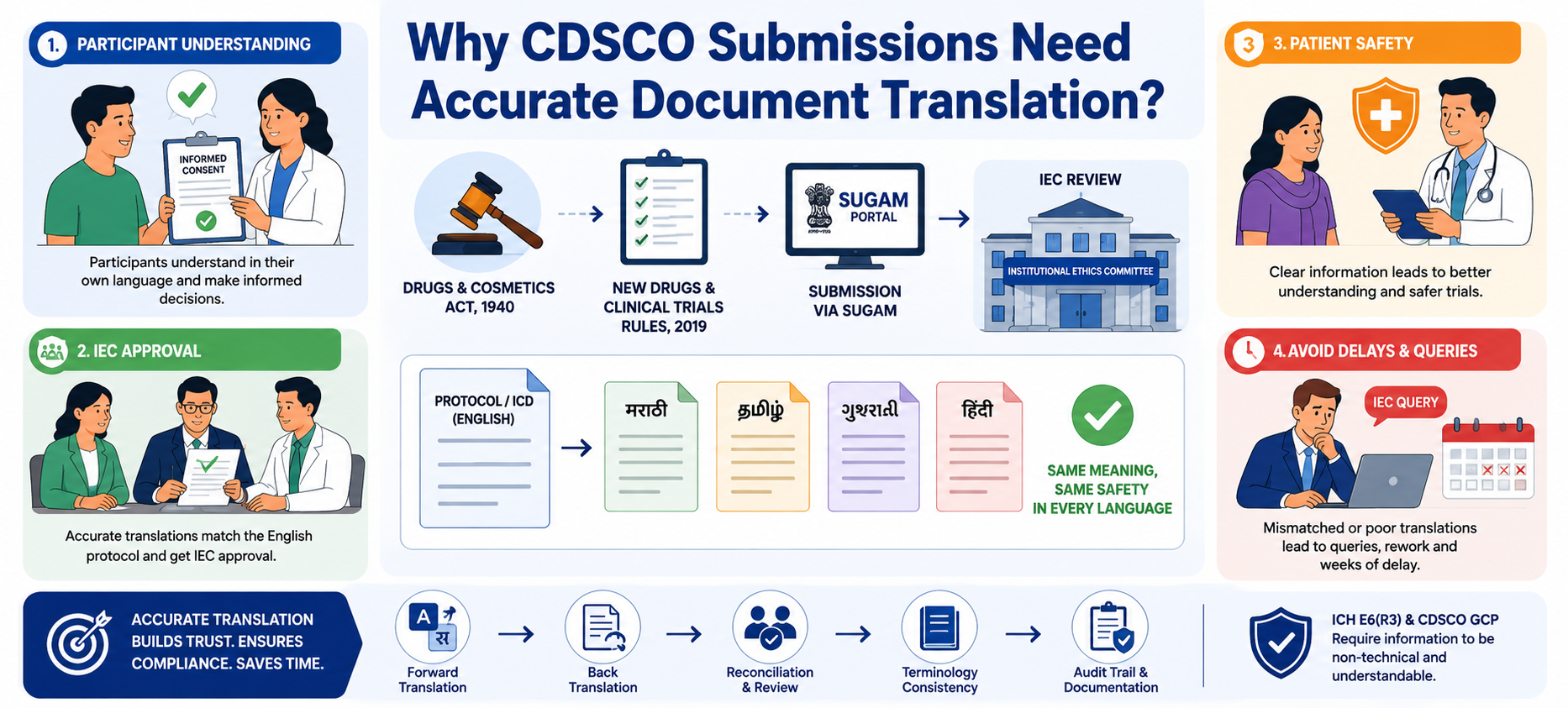
CDSCO operates under the Drugs and Cosmetics Act, 1940, and the New Drugs and Clinical Trials Rules, 2019, and every trial application filed through the SUGAM portal goes through an Institutional Ethics Committee (IEC) review before any site can start enrolling patients. The IEC’s job is to confirm that the people joining the trial actually understand what they are agreeing to, and that understanding cannot happen if the consent document is in a language the participant does not read.
This is where clinical trial document translation CDSCO sponsors submit becomes a compliance step, not a formality. A sponsor running a trial across sites in Maharashtra, Tamil Nadu, and Gujarat needs the same protocol represented correctly in Marathi, Tamil, and Gujarati, with every version saying exactly the same thing as the English source. Any mismatch between language versions gets flagged during IEC review, and that flag turns into a query, and a query turns into weeks of delay.
Comprehensive Summary
- CDSCO Clinical Trial Translation: Every clinical trial application submitted to CDSCO needs participant facing documents translated into the language the trial site actually uses.
- Informed Consent Document Translation: The ICD is the most scrutinized document in any CDSCO submission, and IECs reject applications where the translated version does not match the approved English protocol.
- Back Translation for CDSCO Submissions: Most Indian ethics committees expect a forward translation, an independent back translation, and a reconciliation step before they sign off on patient material.
- Clinical Trial Document Translation CDSCO Process: Sponsors filing through the SUGAM portal need translated ICDs, patient information sheets, and recruitment material ready before the IEC review stage begins.
- Pharma Translation Services India for Trials: Sponsors running multi-site trials across Indian states depend on pharma translation services India providers who can deliver consistent terminology across Hindi, Marathi, Tamil, and other regional languages.
- ICH E6(R3) and CDSCO Alignment: CDSCO’s GCP framework follows ICH E6 guidelines, which state plainly that information given to trial subjects must be simple and understandable in their own language.
- Choosing a Translation Partner for CDSCO Filings: A reliable partner for clinical trial document translation CDSCO work carries medical translators, a documented QA process, and an audit trail sponsors can hand over during inspection.
Key Takeaways:
- Clinical trial document translation CDSCO sponsors need is not optional paperwork; it is a direct input into whether an IEC approves a trial site.
- Pharma translation services India sponsors choose must handle regional Indian languages with the same rigor as English to Hindi or English to Tamil ICDs.
- Back translation, terminology consistency, and an auditable record of every translated version are what separate a smooth CDSCO review from a delayed one.
Need ICD Translation for an Upcoming Trial?
Get a Free Quote
Documents That Need Translation for CDSCO Clinical Trial Applications
A standard CDSCO trial application carries a defined set of documents, and most of them need translation into the local language of every participating site before the IEC reviews them.
Informed Consent Documents (ICDs)
The ICD is the document a trial participant signs before joining a study, and it carries the highest scrutiny of any file in the package. The translated ICD must match the approved English version sentence for sentence in meaning, while reading naturally in the local language. An IEC that finds a discrepancy between the two versions, even a small one, will send the document back for correction before approval moves forward.
Investigator’s Brochure and Protocol Summary
While the full Investigator’s Brochure usually stays in English for the investigator’s reference, a plain language summary of the protocol often needs translation for site staff and ethics committee members who review it in a regional language. This summary must carry the same dosing, eligibility, and risk information as the source protocol without simplification that changes meaning.
Patient Information Sheets and Recruitment Material
Patient information sheets, recruitment advertisements, and any material shown to potential participants before they enroll all fall under the same translation requirement as the ICD. Recruitment material in particular gets reviewed for tone, since anything that reads as persuasive rather than informative can draw an IEC objection.
Serious Adverse Event (SAE) Reports
SAE narratives sometimes need translation when a site reports in a regional language and the sponsor’s pharmacovigilance team works centrally in English. Accuracy here carries direct safety reporting consequences, since CDSCO timelines for SAE reporting do not pause for translation delays.
Submitting to CDSCO via SUGAM Soon?
Get expert advice
CDSCO Rules Every Sponsor Should Know Before Translating Trial Documents
CDSCO’s GCP framework follows ICH E6 guidelines, and ICH E6(R3), adopted in January 2025 and effective globally from July 2025, states clearly that information given to trial subjects must be non-technical and understandable. This single line is the basis for nearly every translation requirement an IEC applies during review.
In practice, this means:
- The ICD must be written at a reading level the average participant at that site can follow, in their own language.
- Every translated document needs a documented translator and reviewer record that the sponsor can produce on request.
- IECs expect translated versions to be reviewed against the source by someone independent of the original translator.
Sponsors that treat translation as a last minute task before filing tend to run into exactly these gaps during review.
Forward Translation vs Back Translation: What CDSCO Reviewers Expect
Most IECs reviewing a clinical trial document translation CDSCO submission expect a two step process, not a single translated draft.
| Step | What Happens | Why IECs Ask for It |
| Forward Translation | Source document (English) translated into the target language by a qualified medical translator | Produces the version participants will actually read |
| Back Translation | A second, independent translator (blind to the source) translates the target language version back into English | Checks whether meaning was preserved without bias from the first translator |
| Reconciliation | A reviewer compares the original English, the back translation, and notes any differences | Confirms the forward translation says what the source says, nothing more or less |
This process takes time, and sponsors who build it into their timeline upfront avoid the scramble that happens when an IEC asks for a back translation report that does not exist yet.
Worried About Back Translation Accuracy?
Talk to us, we have a solution
Common Mistakes in Clinical Trial Document Translation for CDSCO
Sponsors and CROs run into a fairly consistent set of issues when translation is treated as an afterthought:
- Inconsistent terminology across sites: The same drug name or dosage instruction gets translated differently across two regional languages because two different translators worked without a shared glossary.
- Skipping back translation: Some sponsors submit only a forward translation, then face a query from the IEC asking for the back translation report that should have existed from the start.
- Translating before the protocol is final: Last minute protocol amendments mean the translated ICD no longer matches the English version, and nobody catches it until review.
- Using general translators for medical content: A translator without medical training can produce a document that reads fine but gets a key clinical term wrong, which an IEC reviewer will catch immediately.
- No audit trail: When CDSCO or an inspector asks who translated a document and when, sponsors without a documented record cannot answer quickly.
How Pharma Translation Services India Support CDSCO Compliance
A provider offering pharma translation services India sponsors can rely on for trial documentation brings three things to the table that a general translation vendor does not.
First, medical translators who know GCP terminology, dosing language, and how Indian regulatory bodies expect documents to read. Second, a terminology management system that keeps drug names, dosage instructions, and protocol language consistent across every regional language version of the same trial. Third, a documented process, meaning every translated file comes with a record of who translated it, who reviewed it, and when, ready to hand over if CDSCO or an inspector asks for it.
For sponsors running trials across multiple Indian states, this consistency across Hindi, Marathi, Tamil, Telugu, and other regional languages is what keeps a multi-site IEC review moving without repeated queries.
Got Multi-Site Trial Documents to Translate?
Take our help
Choosing the Right Partner for Clinical Trial Document Translation CDSCO Submissions
Before signing on with any provider for clinical trial document translation CDSCO filings, check for:
- Medical translator credentials: Confirm translators have a clinical or life sciences background, not just general scientific translation experience.
- Back translation as standard: The provider should offer forward translation, back translation, and reconciliation as a built-in workflow, not an add-on.
- Regional language coverage: Verify they cover every Indian language your trial sites need, with native translators for each.
- Documented audit trail: Ask how they record translator names, review dates, and version history for each document.
- Confidentiality protocols: Trial protocols and patient data are sensitive, so NDA signing and secure file handling should be standard practice.
Not Sure About Terminology Consistency?
Book a Free Call
Conclusion
Clinical trial document translation CDSCO sponsors submit is one of the few places in a trial application where a small language error can hold up an entire site’s approval. ICH E6(R3) makes the expectation explicit: participants must receive information they can genuinely understand, in their own language, and IECs across India hold sponsors to exactly that standard during review. Getting the ICD, protocol summary, and patient material translated correctly the first time, with forward translation, back translation, and a reconciliation record in place, is what keeps a CDSCO submission moving instead of sitting in query status.
For sponsors and CROs working across multiple Indian states, pharma translation services India providers with medical translators, terminology management, and a documented audit trail are not a nice to have, they are part of getting the trial started on schedule. CMM Languages has supported pharma and life sciences clients with exactly this kind of work from Navi Mumbai for over 18 years, covering 65+ languages including all major regional Indian languages. If your next CDSCO submission needs translated trial documents, reach out us.
FAQs
What documents need translation for a CDSCO clinical trial submission?
Informed consent documents, patient information sheets, recruitment material, protocol summaries, and sometimes SAE reports all need translation into the local language of each trial site.
Does CDSCO require back translation for clinical trial documents?
Most IECs expect a forward translation along with an independent back translation and reconciliation report, especially for informed consent documents.
Why do regional Indian languages matter for CDSCO submissions?
Multi-site trials across Indian states need ICDs and patient material in the language each site actually uses, since IECs review documents for participant understanding in that language.
What happens if translated trial documents do not match the English source?
The IEC will raise a query and may delay approval until the translated version is corrected to match the source protocol exactly.
How do I choose a provider for clinical trial document translation CDSCO needs?
Look for medical translators with clinical backgrounds, a built-in back translation process, coverage of all your site languages, and a documented audit trail for every translated file.
https://shorturl.fm/PbTvA