

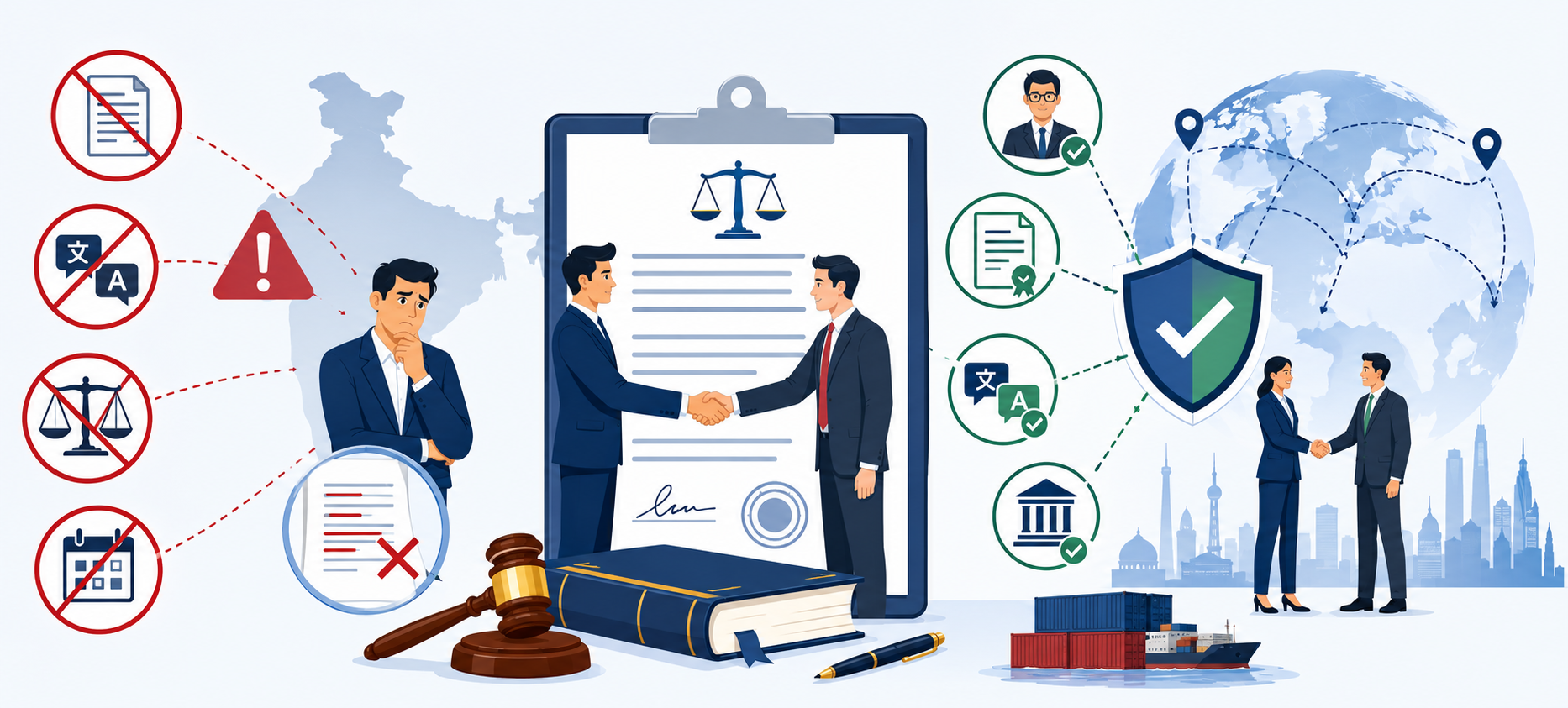
A contract is not really about the words on the page. It’s about the obligations those words create between two parties, and that’s exactly where translation gets risky. A general translator can produce a document that reads smoothly and still get the legal meaning wrong, because legal language doesn’t work like everyday language.
This happens more in cross-border Indian business than most people realize. A Mumbai-based company signing a supply agreement with a German buyer, or a software firm entering a licensing deal with a US partner, both depend on the translated version of the contract holding up exactly the way the original does. When it doesn’t, the gap usually doesn’t show up until something goes wrong and someone pulls out the document to settle it.
COMPREHENSIVE SUMMARY
- A single mistranslated clause in a contract can change what each party is legally bound to do, sometimes without anyone noticing until a dispute arises.
- Indian businesses signing deals with foreign partners often assume a bilingual employee can handle contract translation, which creates risk far bigger than the cost saved.
- Legal terms rarely have a direct one-word equivalent across languages, and a translator without legal training tends to guess at the closest sounding term.
- Notarization and certification requirements differ from country to country, and a contract translated without checking these first can get rejected at the worst possible time.
- Confidentiality matters enormously here, since contracts carry deal terms, financial figures, and clauses neither party wants floating around outside the agreement.
- Courts in India and abroad have both ruled against parties based on translation discrepancies, which makes this a real legal exposure and not a theoretical one.
- Working with the right legal partner from the start of contract drafting, not after signing, catches most of these issues before they become expensive.
KEY TAKEAWAYS:
- Cross-border contracts fail in court more often over translation gaps than most businesses expect, and the cost of fixing this after a dispute is far higher than getting it right at signing.
- A translator without legal background cannot be trusted with a document where one wrong word changes a binding obligation.
- Getting this right from the start protects both the deal and the relationship between the two parties involved.
Got a Cross-Border Contract Ready for Signing?
Get it reviewed and translated by legal-trained linguists before either party signs.
Get a Free Quote
The Pitfall of Using General Translators for Legal Work
Companies trying to save cost often hand contract translation to a bilingual employee or a general translation freelancer instead of someone trained in legal language specifically.
This usually goes fine until it doesn’t. Legal documents carry terms like “indemnification,” “force majeure,” “joint and several liability,” and “governing law,” and these don’t have a clean word-for-word match in most languages. A general translator picks the closest sounding term, the document reads fine on the surface, and nobody catches the gap until a dispute lands in front of a lawyer who actually knows what the original clause was supposed to say.
What This Actually Costs
A mistranslated indemnification clause can shift who pays for damages in a dispute. A poorly translated termination clause can leave one party locked into an agreement they thought they could exit. These aren’t hypothetical outcomes. Indian courts have seen cases where the translated version of a contract created an obligation that the original English version never intended, and the company on the wrong end of that gap paid for it.
The Pitfall of Skipping Notarization Requirements
Every country has its own rules for what makes a translated contract legally valid, and these rules trip up businesses constantly.
Some countries need a certified translation. Others need notarization. Some need both, plus an apostille if the document is going to a country under the Hague Convention. A business that gets a contract translated without checking what the receiving country actually requires often finds out only when the document gets rejected by a registrar, a court, or a government office on the other end.
Where This Bites Hardest
This shows up most in real estate deals, joint venture agreements, and any contract that needs to be filed with a foreign government body. A joint venture agreement between an Indian company and a partner in the UAE, for example, may need the Arabic version notarized in a specific format before local authorities will recognize it. Finding this out after the contract is signed means starting the translation process over, this time under deadline pressure.
Filing a Contract With a Foreign Authority?
We check notarization and certification requirements before translation starts, not after.
Talk to Our Team
The Pitfall of Literal, Word-for-Word Translation
A contract translated word for word often reads correctly in the target language while completely missing what the clause was legally meant to do.
Legal systems don’t always have matching concepts across countries. A term that means one specific thing under Indian contract law might not carry the same legal weight when translated literally into a civil law system like Germany’s or France’s. A translator who doesn’t understand this difference produces a document that looks accurate but creates a different legal outcome than the original intended.
A Practical Example
The phrase “best efforts” in an English-language contract carries a specific, debated legal standard in common law jurisdictions. Translated literally into a language used in a civil law country, it can lose that specific meaning entirely and read as a vague, unenforceable phrase instead. This kind of gap rarely shows up until a dispute forces both sides to argue over what the clause actually obligated them to do.
The Pitfall of Treating Both Language Versions as Equally Binding
Many cross-border contracts get signed with two language versions, and businesses often don’t think carefully about which version actually controls in case of a dispute.
If the contract doesn’t clearly state which language version takes precedence, both sides can end up arguing over two documents that don’t say exactly the same thing. This is avoidable, but only if someone catches it during drafting rather than after a disagreement starts.
What Should Be in Every Bilingual Contract
- A clause specifying which language version is legally binding if there’s a conflict between the two
- Confirmation that both versions were reviewed against each other by someone with legal training in both languages
- A record of who translated and reviewed each version, in case it’s needed later
Signing a Bilingual Contract Soon?
Make sure both versions say exactly the same thing before anyone signs.
Request a Quote
The Pitfall of Ignoring Confidentiality During Translation
Contracts carry deal terms, pricing, and clauses that neither party wants exposed, yet some businesses send these documents to freelance translators or unsecured online tools without thinking twice.
A contract sent through a free online translation tool doesn’t stay private. Data from these tools can be stored, used for training, or exposed in ways the business never agreed to. Sending a sensitive merger agreement or supply contract through an unsecured channel is a real risk, not a minor inconvenience, especially when the deal itself depends on confidentiality holding until signing.
What a Proper Process Looks Like
A signed NDA before any document changes hands, secure file transfer instead of email attachments sent to personal addresses, and a clear policy on who within the translation team actually sees the document, these are the basics any business should expect before sharing a contract for translation.
How Legal Translation Services in India Help Avoid These Pitfalls
The businesses that avoid these problems almost always have one thing in common: they bring in legal translation services in India with actual legal training, not general linguists, and they do it during drafting, not after signing.
A proper legal translation team checks for the things a general translator misses. They flag terms that don’t have a clean equivalent across legal systems instead of guessing. They confirm notarization requirements with the receiving country before starting work. They build in a governing language clause if one isn’t already there. And they treat the document with the same confidentiality a law firm would, NDA included.
Need Legal Translation for an Upcoming Deal?
Get contracts translated by linguists with actual legal training, not general translators.
Book a Free Consultation
What to Check Before Choosing a Translation Partner for Contracts
A few things separate a provider who can actually handle legal work from one who’s just offering general translation under a different label.
- Legal background, not just language skill. Ask specifically whether the translator assigned has legal training or contract law experience, not just fluency in both languages.
- Notarization and certification know-how. They should be able to tell you upfront what the receiving country requires, before translation even starts.
- Confidentiality as standard practice. NDA signing and secure file handling shouldn’t be something you have to ask for separately.
- Experience with your specific contract type. A team that’s handled supply agreements isn’t automatically equipped for IP licensing or joint venture contracts. Ask directly.
- A second legal reviewer. The best providers have someone separate from the translator review the document against the original before it goes back to you.
A business contract translation in Mumbai companies can actually depend on should walk you through every one of these points before quoting you a price.
Conclusion
Cross-border contracts fail more often over translation gaps than anyone expects going into the deal. A wrong term in an indemnification clause, a missing governing language provision, or a translation done without checking notarization requirements can turn what should have been a clean signing into a legal mess that costs far more to fix than it would have cost to get right the first time.
Getting contract translation right means treating it as legal work, not language work. Legal translation services in India that bring actual contract law experience, proper confidentiality practices, and a second reviewer checking the document against the original catch these problems before they become disputes. CMM Languages has supported Indian businesses through exactly this kind of cross-border contract work since 2008.
FAQs
What’s the biggest risk in legal contract translation?
A mistranslated clause can change what each party is legally obligated to do, and this often doesn’t surface until a dispute forces someone to compare the two versions.
Why can’t a bilingual employee handle contract translation?
Legal terms carry specific meanings that don’t translate word for word, and someone without legal training is likely to miss that gap entirely.
Does every country need the same type of certified translation?
No, requirements for notarization, certification, and apostilles vary by country, and businesses should confirm this before translation starts, not after submission.
What should a bilingual contract always include?
A clause stating which language version is legally binding in case of a conflict between the two versions.
How do I find reliable business contract translation in Mumbai?
Look for a provider with legal-trained translators, confidentiality protocols, a second reviewer process, and direct experience with your specific contract type.
https://shorturl.fm/nnan2