

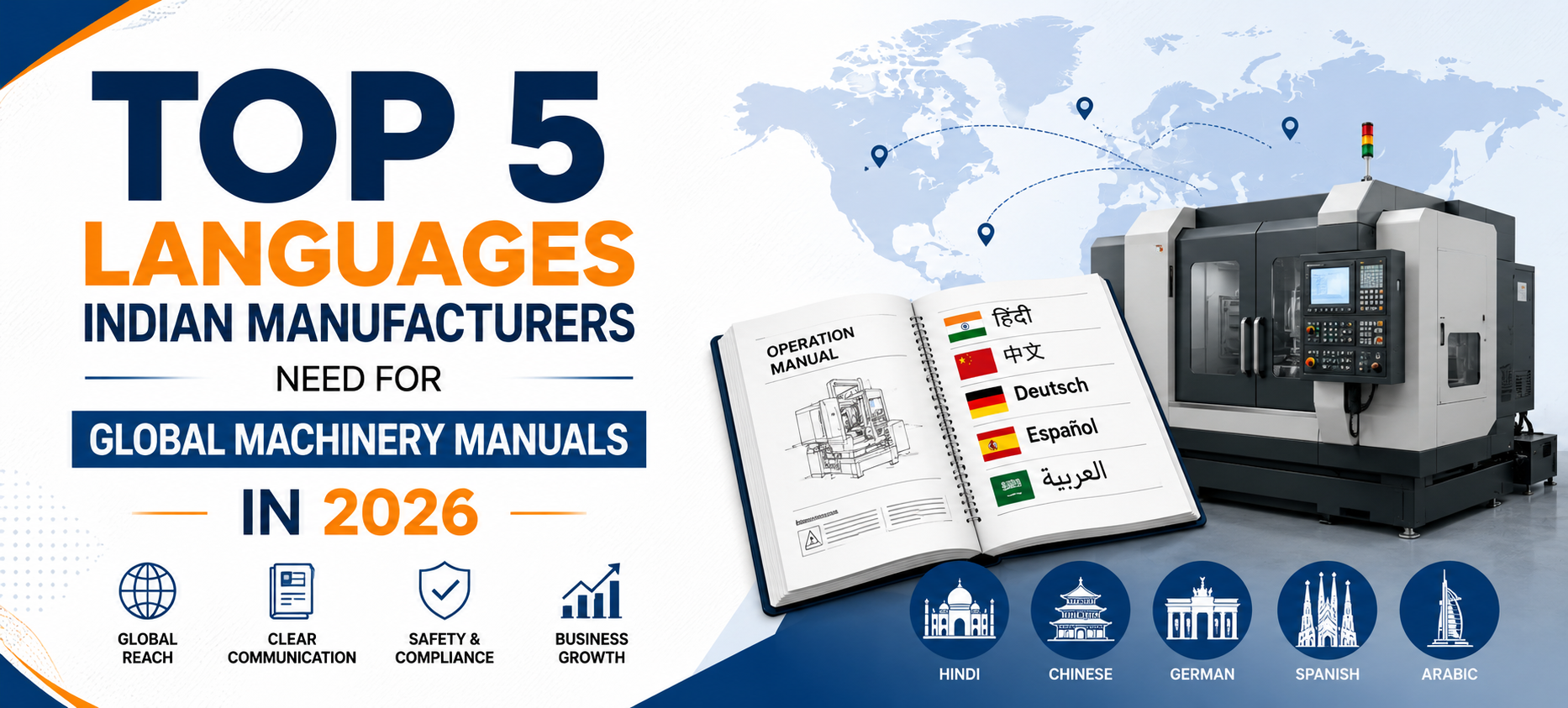
Machinery manual translation is not a paperwork formality. A site engineer in Riyadh or Frankfurt who cannot read the startup sequence either calls your support team repeatedly or installs the machine incorrectly. Both outcomes cost you time, money, and the buyer’s trust on the next order. The five languages below cover the markets where Indian machinery exports are seeing the strongest movement right now.
India’s engineering goods exports hit a record USD 122.43 billion in FY26, growing 4.86% over the previous year and now making up 27.71% of the country’s total merchandise exports. (source) Behind every shipment in that number is a manual, a safety sheet, and an installation guide that the buyer’s engineer needs to actually use.
Comprehensive Summary
- Machinery Manual Translation Demand: India’s engineering exports touched USD 122.43 billion in FY26, and every machine shipped abroad carries a manual that the buyer’s site team must be able to read.
- German for Machinery Manuals: Germany remains a steady buyer of Indian engineering goods, and German-language manuals are non-negotiable for CE marking and EU market entry.
- Arabic for Machinery Manuals: WANA markets including Saudi Arabia and the UAE take a large share of India’s engineering exports, making Arabic manuals a core requirement for Gulf-bound machinery.
- Spanish for Machinery Manuals: Mexico and other Latin American buyers expect Spanish documentation, and this region keeps showing up as a growth market for Indian machinery exporters.
- French for Machinery Manuals: France posted strong growth in Indian engineering exports recently, and French-language manuals open doors across France and several African Francophone markets.
- Japanese for Machinery Manuals: Japan continues to import Indian engineering goods steadily, and Japanese buyers expect technical documentation in Japanese with precise unit and safety terminology.
- Technical Translation Services in India for Manuals: thesehandle multi-format files and domain-specific terminology are what make manuals usable across all five of these languages.
Key Takeaways:
- Machinery manual translation decides whether your equipment gets installed correctly on day one or sits idle while the buyer’s team waits for clarification.
- German, Arabic, Spanish, French, and Japanese cover the markets where Indian engineering exports are growing fastest in 2026.
- Technical translation services in India that handle AutoCAD files, safety labels, and domain terms make manual translation a one-time process done right, not a recurring headache.
Got a Tender Document Due Soon?
Get Started With Us
Top 5 Languages That Matter Most for Machinery Manuals in 2026
Picking the right languages for your manuals comes down to where your machines are actually going, and FY26 export data points clearly toward five markets. Each of these languages carries its own formatting rules, terminology expectations, and buyer standards, so treating them as one-size-fits-all translation work usually backfires. Here is a closer look at each one, starting with the market that has stayed the most consistent for Indian exporters over the years.
1. German: Still the Anchor for European Machinery Buyers
Germany has stayed a consistent destination for Indian engineering shipments through FY26, with the EU overall growing 8.6% over the fiscal year. A German manual is also tied directly to CE marking, since the EU Declaration of Conformity and supporting documentation often need to be available in the buyer’s language before customs clearance and certification go through smoothly.
German engineering vocabulary is precise to the point where a wrong term for “torque” or “load rating” gets flagged immediately by a German technical reviewer. This is one language where domain-trained translation is not optional.
2. Arabic: The Gulf Market Keeps Growing
West Asia and North Africa (WANA) accounted for 16.7% of India’s engineering exports in FY25, and Gulf buyers in Saudi Arabia and the UAE continue to import machinery across construction, manufacturing, and power sectors. An Arabic manual for this market needs to account for right-to-left text layout, which changes how diagrams, labels, and step numbers get placed on the page compared to the English source.
Arabic also varies by region in vocabulary and tone, so a manual translated for a Saudi buyer should read naturally to a Saudi engineer, not like a generic Arabic translation built for any market.
3. Spanish: Latin America’s Growing Pull
Mexico and other Latin American markets show up repeatedly in EEPC export data as growth destinations for Indian engineering goods. Spanish manuals for this region need Latin American Spanish, not the Castilian Spanish used in Spain, since the two read differently to their respective audiences and using the wrong one signals the manual was not built for that buyer.
Equipment going to Mexico in particular often needs measurement conversions handled carefully, since metric and imperial units sometimes appear side by side in buyer documentation expectations.
4. French: A Gateway Beyond France Itself
France recorded strong export growth for Indian engineering goods recently, and French manuals serve a wider purpose than France alone. Several Francophone markets across West and Central Africa use French as their working technical language, so a well-translated French manual can support multiple destination markets from a single translation project.
Tender documents for French-speaking government projects also need this level of accuracy, since technical scope and legal terms both carry weight in bid evaluation.
Need French or Spanish Manuals for a New Market?
Request a Quote
5. Japanese: Precision Buyers With High Documentation Standards
Japan has remained a steady importer of Indian engineering goods through FY26, with positive growth recorded across recent months. Japanese buyers hold technical documentation to a very high standard, and manuals translated for this market need exact unit conversions, precise safety terminology, and a level of formality that matches how Japanese technical writing is structured. A manual that reads as casual or imprecise in Japanese creates an impression that carries over to how the buyer views the product itself.
How Technical Translation Services in India Handle Multi-Language Manuals
Manufacturers shipping to all five of these markets do not need five separate vendors. Technical translation services in India that work across AutoCAD drawings, PDF manuals, and InDesign layouts can take one source manual and produce German, Arabic, Spanish, French, and Japanese versions that all carry the same technical accuracy, with formatting preserved for each language’s layout needs, including right-to-left Arabic and longer German text strings.
A translation memory built during the first project also keeps terminology consistent across every future manual update, so a Year 2 revision does not mean starting from zero in five languages again.
Need Help in Translating One Manual Into Multiple Languages?
Book a Free Consultation
Conclusion
India’s engineering exports crossed USD 122.43 billion in FY26, and the markets driving that number, the EU, the Gulf, Latin America, Francophone Africa, and Japan, all expect machinery manuals in their own language before a single unit gets installed. Machinery manual translation done right the first time means fewer support calls, faster installations, and a buyer who trusts your product from the moment it arrives.
If your manuals are still sitting in English only while your export markets expand, that gap is worth closing now rather than after the first complaint comes in. CMM Languages has handled manual translation for engineering exporters across all five of these languages for 18+ years from Navi Mumbai. Reach out to us to get started.
FAQs
Which languages do Indian machinery exporters need most in 2026?
German, Arabic, Spanish, French, and Japanese cover the markets showing the strongest growth for Indian engineering exports this year.
Why does Arabic manual translation need special handling?
Arabic reads right to left, which changes diagram placement and page layout, and the language itself varies by region across Gulf markets.
Is Latin American Spanish different from European Spanish for manuals?
Yes, Latin American Spanish and Castilian Spanish use different vocabulary, and manuals for Mexico should use the Latin American version.
Can one provider handle manual translation into all five languages?
Yes, technical translation services in India that work across multiple file formats can deliver all five languages from a single source manual with consistent terminology.
Why does machinery manual translation matter for buyer trust?
A site engineer who can read the manual installs the machine correctly the first time, which builds confidence in the product and the brand from day one.