

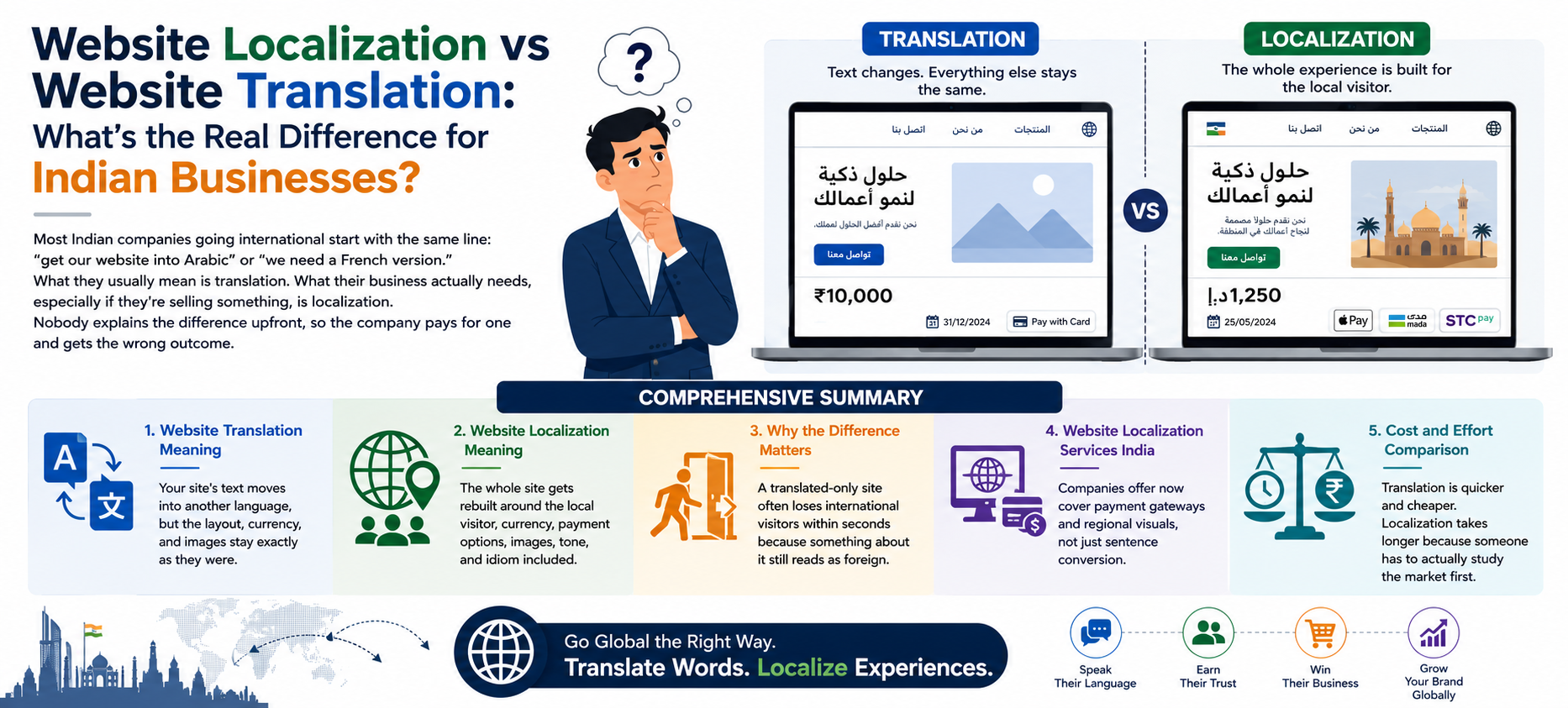
Website Localization vs Website Translation: What’s the Real Difference for Indian Businesses?
Most Indian companies going international start with the same line: “get our website into Arabic” or “we need a French version.” What they usually mean is translation. What their business actually needs, especially if they’re selling something, is localization. Nobody explains the difference upfront, so the company pays for one and gets the wrong outcome.
This mix-up shows up fast once the new version goes live. The text reads fine. The visitor still leaves. Something about the page feels off to them, even if they can’t name it, because the prices are still in rupees, the date format is wrong for their country, or the payment options on checkout don’t include anything they recognize.
COMPREHENSIVE SUMMARY
- Website Translation Meaning: Your site’s text moves into another language, but the layout, currency, and images stay exactly as they were.
- Website Localization Meaning: The whole site gets rebuilt around the local visitor, currency, payment options, images, tone, and idiom included.
- Why the Difference Matters: A translated-only site often loses international visitors within seconds because something about it still reads as foreign.
- Website Localization Services India: Companies offer now cover payment gateways and regional visuals, not just sentence conversion.
- Cost and Effort Comparison: Translation is quicker and cheaper. Localization takes longer because someone has to actually study the market first.
- Website Translation Company Mumbai: It has to offer should be upfront about which of the two you actually need, even if one pays them less.
KEY TAKEAWAYS:
- Website localization services India brands need go past swapping English words for local ones on the same page.
- Translation and localization fix different problems, and using the wrong one for your goal burns budget without moving the needle.
- A website translation company Mumbai businesses trust should tell you honestly which service fits, not just sell you the bigger package.
Not Sure If You Need Translation or Localization?
Get a free site audit from CMM Languages and find out exactly what your website needs.
Book a Free Audit
What Website Translation Actually Means
Website translation moves your text from one language to another. Nothing else on the page changes.
The navigation labels, the product copy, the blog posts all get translated word for word into the new language. But the rupee symbol stays. The images stay. The date still reads day-month-year if that’s how your original site built it, regardless of whether the visitor’s country reads dates that way at all.
This is fine for a blog, a knowledge base, or a documentation page where someone just needs to read your content in their language. It falls apart fast on a site where the visitor is expected to trust you enough to pay you.
Where Translation Alone Works Fine
- Company blogs and informational articles
- Internal documentation or knowledge base content
- Press releases and announcements
- Sites where the goal is simply being read, not converting a sale
What Website Localization Actually Means
Localization starts with translation and then changes everything around it so the page feels native to wherever it’s landing.
Take a site going into the German market. Prices show in euros. Dates flip to day-month-year if your source used a different format, or get adjusted to match German convention precisely. Payment options reflect what German shoppers actually use. Stock photography that reads as distinctly Indian or American gets swapped for something that doesn’t pull the visitor’s attention away from your product. Even the writing tone shifts. German business copy tends to be direct and formal. A page localized for the UAE often reads warmer, more relationship-first.
Idioms get rewritten, not translated. An English phrase that lands naturally often turns into nonsense or just sounds stiff when carried word for word into Arabic or Japanese. A translator catches the words. A localization team catches the meaning underneath them and rebuilds it in a way the new audience actually responds to.
Selling Directly to International Customers?
Currency, payment gateways, and content built for the local market, this is what gets visitors to actually buy.
Talk to Our Team
Translation vs. Localisation, Compared Directly
| Factor | Website Translation | Website Localization |
| What changes | Text only | Text, currency, images, payment methods, tone |
| Turnaround | Faster | Slower, needs market research first |
| Cost | Lower | Higher, but pays off on conversion-driven sites |
| Fits best | Blogs, docs, informational pages | E-commerce, service businesses, B2C expansion |
| Visitor’s reaction | “I can read this” | “This was made for me” |
| Effect on sales | Minor | Direct and measurable |
Why This Matters More for Indian Businesses Specifically
India sells into markets that don’t look anything alike. A Gulf customer and a German customer have almost nothing in common in how they expect a website to behave, and treating both with the same generic “translation” approach burns the opportunity in both places.
Selling Into the Gulf
A customer in the UAE browsing your site in Arabic expects the layout to run right to left, prices in AED, and payment options like mada or a regional bank transfer at checkout. Translate the English copy into Arabic but leave the layout running left to right with INR pricing, and the visitor hits friction the moment they try to pay.
Selling Into Europe
A French or German visitor expects GDPR-compliant cookie language, local currency, and a tone that matches how business gets done in their market. Website localization services India providers now build this in as part of the project, not as something you ask for separately and pay extra.
Expanding Into Gulf or European Markets?
CMM Languages handles currency, RTL layout for Arabic, payment gateway text, and content that actually fits the market.
Request a Quote
So Which One Does Your Site Actually Need?
Go with translation if your site is informational and you’re not asking visitors to pay you directly. A blog, a documentation hub, or a content site built to test interest in a new market doesn’t need the full localization treatment yet.
Go with localization once money changes hands on your site, or once trust and cultural fit start mattering to whether someone clicks “buy.” E-commerce sites, service businesses, and any brand entering a market with a genuinely different currency, payment culture, or communication style need this from day one, not after the first quarter of poor conversions tells you so.
Still Deciding Between the Two?
Send us your website and we’ll tell you straight which option actually fits your business.
Get a Free Consultation
What to Check Before Picking a Website Translation Company Mumbai Offers
A few things separate a provider who’ll do this right from one who’ll just hand you translated text and call it done.
- They offer both services honestly. If every conversation ends in “you need full localization” regardless of what you actually asked for, that’s a sales pitch, not advice.
- They’ve worked your target market before. A team that’s localized for the Gulf knows things about that market a team that’s only worked on European sites won’t.
- They work inside your actual CMS. WordPress, Shopify, custom-built, whatever you’re running, they should be able to work within it without breaking your site structure.
- Native speakers handle tone and idiom. Not someone fluent in the language. Someone who grew up reading marketing copy in that language and knows what sounds off.
- They can show you finished, live sites. Not just sample paragraphs. Ask to see something they’ve actually shipped.
A website translation company Mumbai businesses can rely on should walk through this list with you on the first call, before any contract gets signed.
Need a Website Translation Company Mumbai Trusts?
CMM Languages has delivered website translation and localization for Indian businesses since 2008.
See Our Work
Conclusion
The real question isn’t translation versus localization. It’s whether you want visitors abroad to read your site or actually buy from it. Translation gets you the first one, cheaper and faster. Localization gets you the second, and for any Indian business taking money from customers in a new country, that’s the one that actually moves revenue.
Website localization services India brands rely on today need to cover currency, payment behavior, layout direction, and tone, especially across markets as different as the Gulf, Europe, and Southeast Asia. CMM Languages has built both translation and full localization projects for Indian businesses since 2008, and they’ll tell you straight which one your site needs before recommending either.
FAQs
What’s the real difference between website translation and localization?
Translation changes your text into another language. Localization changes currency, payment options, images, and tone so the whole site fits the local market.
Do I need localization for every new country I enter?
No. An informational site can run on translation alone. A site that sells directly usually needs localization to convert visitors into customers.
Why does localization cost more than translation?
Someone has to research the market, source the right currency and payment data, and adapt tone and imagery, which takes more time than translating text line by line.
Why does Arabic need more than just translated text?
Arabic reads right to left, and Gulf customers expect local currency and regional payment options that plain translation never touches.